Publications

JOP Forthcoming

Elite Rhetoric and the Running Tally of Party-Group Linkages
With Christoffer Dausgaard · The Journal of Politics

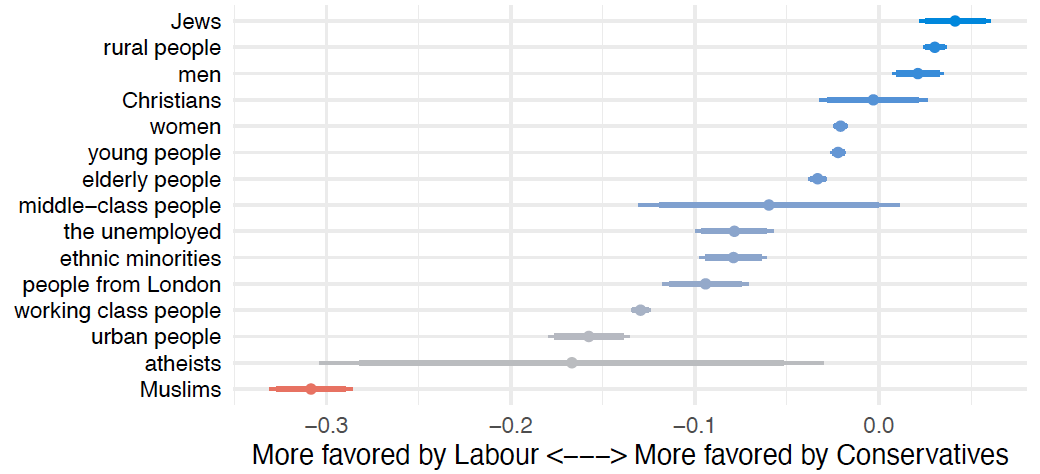
Parties’ linkages to social groups are key to electoral competition. While traditionally explained in terms of long-standing social cleavages, newer theories assign some role to parties in shaping group linkages. We argue that party elites have even more influence over group linkages than afforded in existing accounts: citizens keep ‘running tallies’ of group linkages and continuously update them in response to group appeals in elite rhetoric. To test this theory, we develop a novel automated approach that uses language models to measure group appeals observationally. Using data from the UK, we connect citizens’ perceived group linkages in surveys to group appeals in parliamentary speech spanning three decades. We find that group linkages robustly track party elites’ rhetoric. Auxiliary analyses test heterogeneity across group types and the moderating role of policy information. Our findings imply that party elites have considerable power to shape group linkages, even in the short run.

CPS Forthcoming

Losing Touch: The Rhetorical Cost of Governing

Comparative Political Studies

Governments lose votes over time. This regularity is so well-documented that the ‘cost of governing’ is widely considered a law-like phenomenon. However, our understanding of the causes of the cost of governing is incomplete. This paper presents a novel perspective on this question, considering how rhetorical constraints impose costs on governments. Specifically, I argue that while legislators generally seek to satisfy voter demands for maximal rhetorical simplicity, the functional demands of running government compel legislators to speak less simply when serving in government. This structural condition provides the opposition with a rhetorical advantage vis-à-vis the government, eventually leading to electoral losses for the incumbent government. I refer to this as ‘the rhetorical cost of governing’. I test this theory in the context of the Danish parliament, from which I combine rich data on individual legislator careers with the complete record of parliamentary speech across three decades. Consistent with the theory, legislators speak with reduced simplicity while serving in government. Additional analyses suggest the effect is driven by constraints on government members’ issue emphasis. The results add to our understanding of the cost of governing and the drivers of mass grievances fueling populist political movements.

PSRM Cond. accepted

Partisan Conflict in Nonverbal Communication

With Mathias Rask · Political Science Research and Methods

In multiparty systems, parties signal conflict through communication, yet standard approaches to measuring partisan conflict in communication consider only the verbal dimension. We expand the study of partisan conflict to the nonverbal dimension by developing a measure of nonverbal conflict signaling based on variation in speakers’ vocal pitch. We demonstrate our approach using comprehensive audio data from parliamentary debates in Denmark spanning more than two decades. We find that nonverbal conflict signals reflect prevailing patterns of partisan polarization and predict subsequent legislative behavior. Moreover, we show that consistent with a strategic model of behavior, nonverbal conflict signals track the electoral and policy incentives faced by legislators. All results persist when we account for the verbal content of speech. By documenting a novel dimension of elite communication of partisan conflict and providing evidence for the strategic use of nonverbal signals, our findings deepen our understanding of the nature of elite partisan communication.

JOP Forthcoming

Reining in the Rascals: Challenger Parties’ Path to Power

With Jacob Nyrup and Martin Vinæs Larsen · The Journal of Politics

Challenger parties, i.e. parties without prior government experience, have transformed politics in Europe and beyond, some eventually joining governing coalitions. However, the process by which challenger parties gain access to power remains unclear. We argue that holding elected office in itself improves challenger parties’ chances of entering government. We find support for this expectation in cross-sectional, national-level data. To establish causality, we apply a regression discontinuity design to an original data set of more than 2,500 elections and 15,000 committee assignments from local governments in Denmark. We show that legislative incumbency increases challenger parties’ access to government in the following electoral term. Lastly, using data from candidate surveys, we show that incumbent challenger parties take more moderate positions and use more mainstream language, consistent with a moderation mechanism. Our findings shed new light on the causes of challenger party success and, more broadly, the centripetal forces driving party system change.

APSR

Do Violent Protests Affect Expressions of Party Identity? Evidence from the Capitol Insurrection

With Gregory Eady and Peter Thisted Dinesen · American Political Science Review

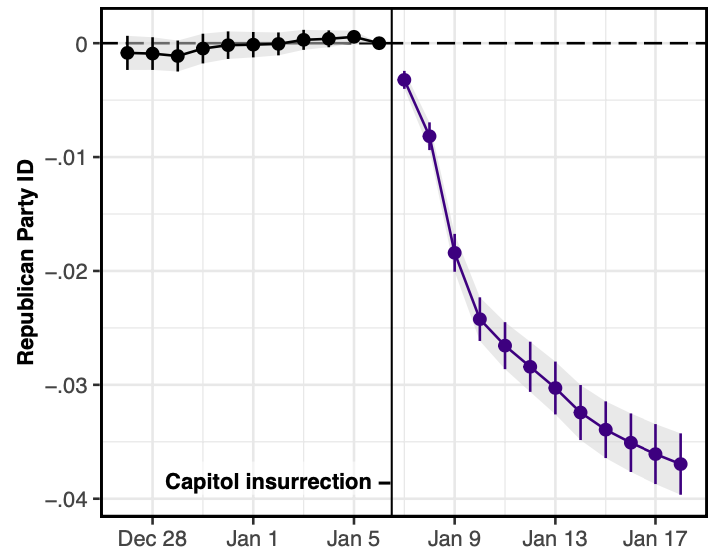
The insurrection at the United States Capitol on January 6, 2021 was the most dramatic contemporary manifestation of deep political polarization in the United States. Recent research shows that violent protests shape political behavior and attachments, but several questions remain unanswered. Using day-level panel data from a large sample of US social media users to track changes in the identities expressed in their Twitter biographies, we show that the Capitol insurrection caused a large-scale decrease in outward expressions of identification with the Republican Party and Donald Trump with no indication of re-identification in the weeks that followed. This finding suggests that there are limits to party loyalty: a violent attack on democratic institutions sets boundaries on partisanship, even among avowed partisans. Further, the finding that political violence can deflect co-partisans carries the potential positive democratic implication that those who encourage or associate themselves with such violence pay a political cost.

JOP

Sheltering Populists? House Prices and the Support for Populist Parties

With Ben Ansell, Jacob Nyrup, and Martin Vinæs Larsen · The Journal of Politics

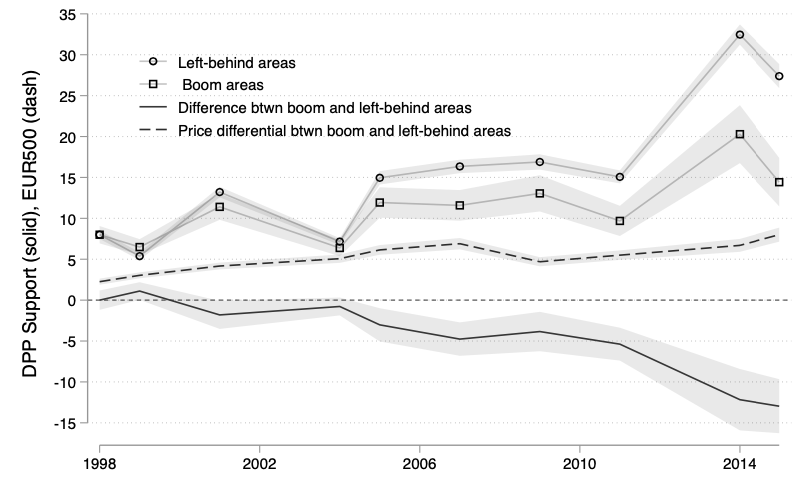
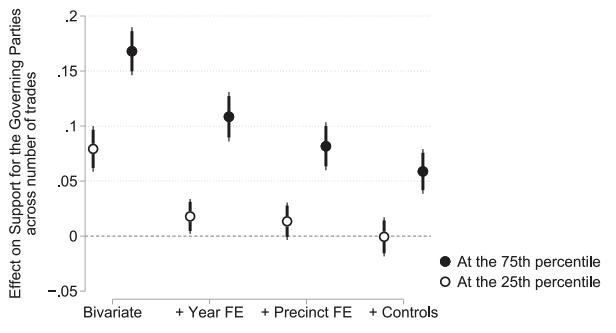
Populist parties, particularly from the right of the political spectrum, have sharply increased their electoral support in recent years, creating great media and scholarly interest. In this article we suggest that the housing market may have been important in defining who switched to populist voting and where they were located. We build on existing work that connects house prices to “first-dimension politics” of redistribution and classic left-right political identification to argue that house prices might also shape preferences on the “second dimension” of politics: support for populist nationalism versus liberal cosmopolitanism. Using both novel precinct- and individual-level data from Denmark, we show that negative shocks to house prices over the election cycle are strongly associated with shifts to support for the Danish People’s Party, a pattern that has amplified over recent elections. We then turn to corroborate this relationship using local housing data in Sweden, Norway, and Finland.

BJPS

When Does Accommodation Work? Electoral Effects of Mainstream Left Position Taking on Immigration

With Martin Vinæs Larsen · British Journal of Political Science

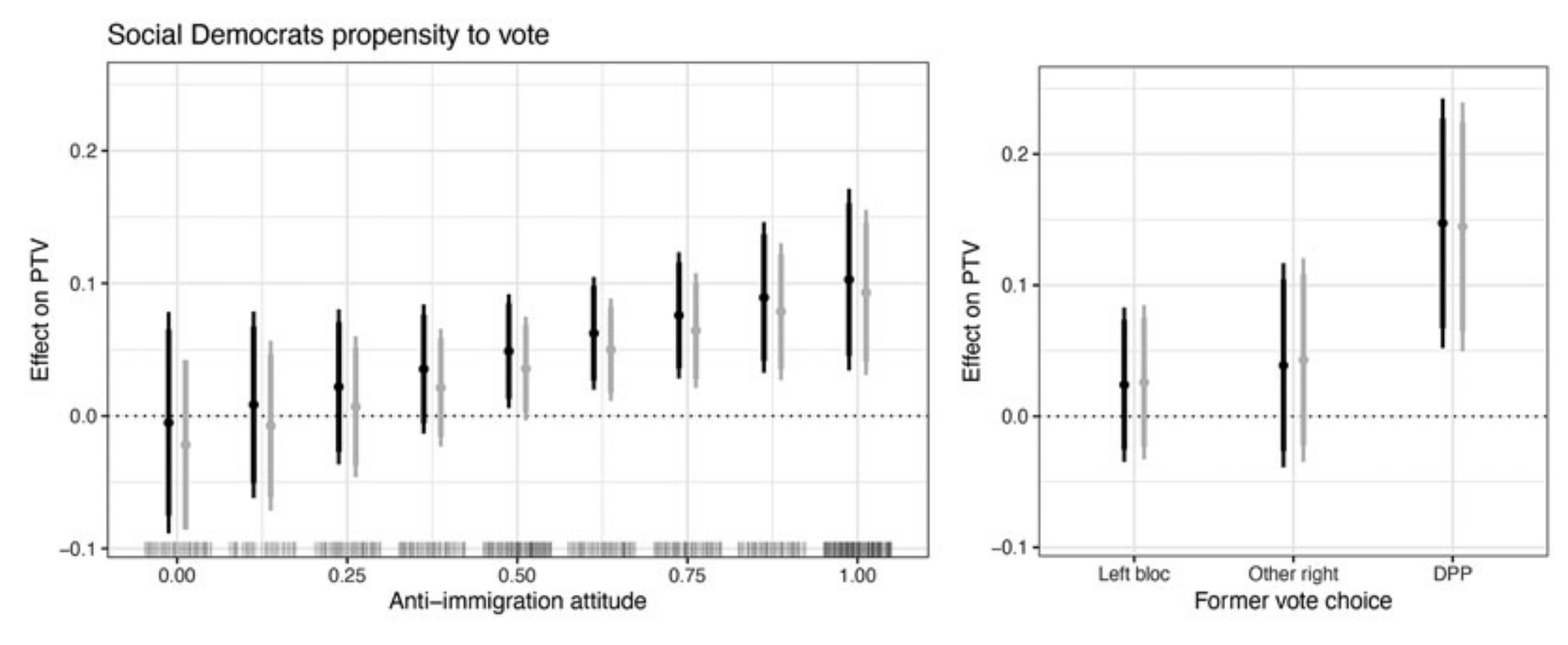
In many countries, right-wing populist parties have gained electoral support by attracting voters from mainstream left parties. This has prompted public and scholarly debate about whether mainstream left parties can regain political power by taking a more restrictive position on immigration, a so-called accommodation strategy. However, selection bias confounds observational estimates of the effectiveness of this strategy. This letter reports the results of a survey experiment conducted among Danish voters during a unique political situation in which the mainstream left party’s position on immigration is ambiguous, enabling experimental manipulation of voters’ perceptions of the party’s position. The authors show that, consistent with spatial models of politics, accommodation attracts anti-immigration voters and repels pro-immigration voters. Because repelled voters defect to other left parties, while attracted voters come from right parties, accommodation increases overall support for parties that support a mainstream left government. The results demonstrate that in some contexts, accommodation can improve the political prospects of the mainstream left.

BJPS

The Influence of Local Ethnic Diversity on Group-Centric Crime Attitudes

British Journal of Political Science

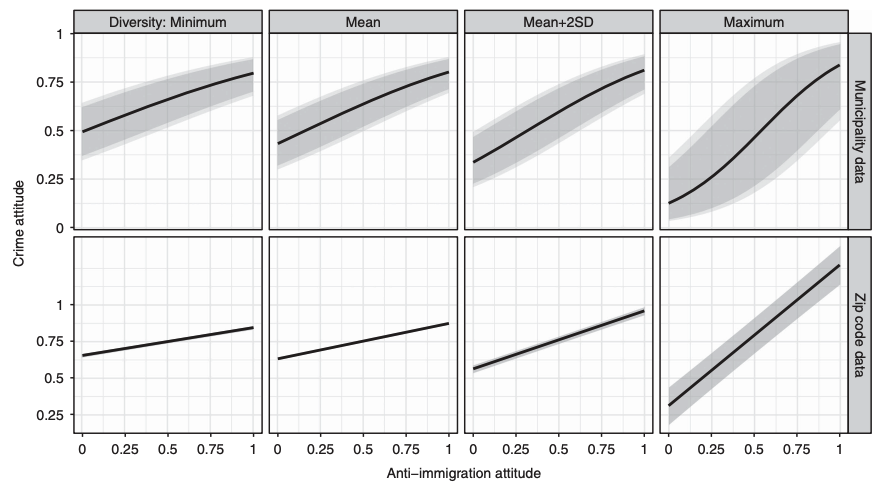
Several studies provide evidence of group-centric policy attitudes, that is, citizens evaluating policies based on linkages with visible social groups. The existing literature generally points to the role of media imagery, rhetoric and prominent political sponsors in driving group-centric attitudes. This article theorizes and tests an alternative source: exposure to rising local ethnic diversity. Focusing on the issue of crime, it first develops a theoretical account of how casual observation in the local context can give rise to ethnic stereotypes. Then, using two large, nationally representative datasets on citizen group and policy attitudes linked with registry data on local ethnic diversity, each spanning 20 years, it shows that crime attitudes become more strongly linked with immigration attitudes as local ethnic diversity rises. The results suggest that the typically emphasized ‘top-down’ influence on group-centric attitudes by elite actors is complemented by ‘bottom-up’ local processes of experiential learning about group–policy linkages.

APSR

When Do Citizens Respond Politically to the Local Economy? Evidence from Registry Data on Local Housing Markets

With Martin Vinæs Larsen, Peter Thisted Dinesen, and Kim Sønderskov · American Political Science Review

J. Comm. 2019

Ideological Asymmetry in the Reach of Pro-Russian Digital Disinformation to US Audiences. Journal of Communication, 69(2), 168–192. With Rebecca Adler-Nissen.

AEJ:EP 2019

Sustaining Honesty in Public Service: The Role of Selection. American Economic Journal: Economic Policy, 11(4), 96–123. With Sebastian Barfort, Nikolaj Harmon, and Asmus Leth Olsen.

Forskning & formidling på dansk

Ø&P 2019

Affektiv Polarisering i Danmark: Et Listeeksperiment om Social Distance til Politiske Modstandere. Økonomi & Politik, 92(3). Med Peter Thisted Dinesen og Kim Mannemar Sønderskov.

Samf. 2019

Trump som issue-entreprenør. Samfundsøkonomen, no. 3.

Politica

Maskinlæring som politologisk værktøj. Politica, 51(2), 168–186. Med Alexander Bach & Jesper Svejgaard.

Kapitel

Issue voting ved folketingsvalget 2015. I Oprør fra udkanten — Folketingsvalget 2015. Jurist- og Økonomforbundets Forlag.

Kapitel

Emneejerskab — hvilke partier ejer hvilke emner? I Oprør fra udkanten — Folketingsvalget 2015. Jurist- og Økonomforbundets Forlag.

Kapitel

Meningsmålinger i valgkampen. Med Jens Olav Dahlgaard, Martin Vinæs Larsen & Asmus Leth Olsen. I Oprør fra udkanten — Folketingsvalget 2015. Jurist- og Økonomforbundets Forlag.

Other publications

Handbook Forthcoming

Attitudes toward Immigration: Theories, Settings, and Approaches. The Oxford Handbook of Behavioral Political Science. With Peter Thisted Dinesen.

JPART 2019

Behavioral Dishonesty in the Public Sector. Journal of Public Administration Research and Theory, 29(4), 572–590. With Asmus Leth Olsen, Nikolaj Harmon, and Sebastian Barfort.

PRQ 2016

Intergroup Bias in Parliamentary Rule Enforcement. Political Research Quarterly, 69(4), 692–702.

EUP 2016

R&P 2015

Computers, coders, and voters: Comparing automated methods for estimating party positions. Research and Politics. With Robert Klemmensen, Sara Hobolt, Martin Ejnar Hansen, and Peter Kurrild-Klitgaard.